
The National Association of Women in Construction (NAWIC) celebrates its annual Women in Construction Week™ from March 1st to March 7th this year to promote the role of women in the construction industry. This year’s theme, "Level Up. Build Strong," highlights the shift from simply entering the workforce to taking leadership and ownership roles. This progress is especially vital as the industry faces a chronic workforce shortage. Current projections indicate the sector must attract an estimated 349,000 net new workers in 2026 alone to meet demand and offset a wave of retiring professionals.
The last decade has experienced consistent year-over-year growth in the number of women in the construction industry. The most recent data reveals an increase of 22,000 women from 2024 to 2025, upping the total to 1,36 million or 11.3% of the total workforce. To gain more insight on how women are making strides in the industry as well as what obstacles remain, we have analyzed the latest data and gathered opinions from influential women in the construction.
Expert Contributors:
Dawn Collins | Julia Bykhovskaia | Rita Brown Founder, Brown Construction Collective (BCC+) |
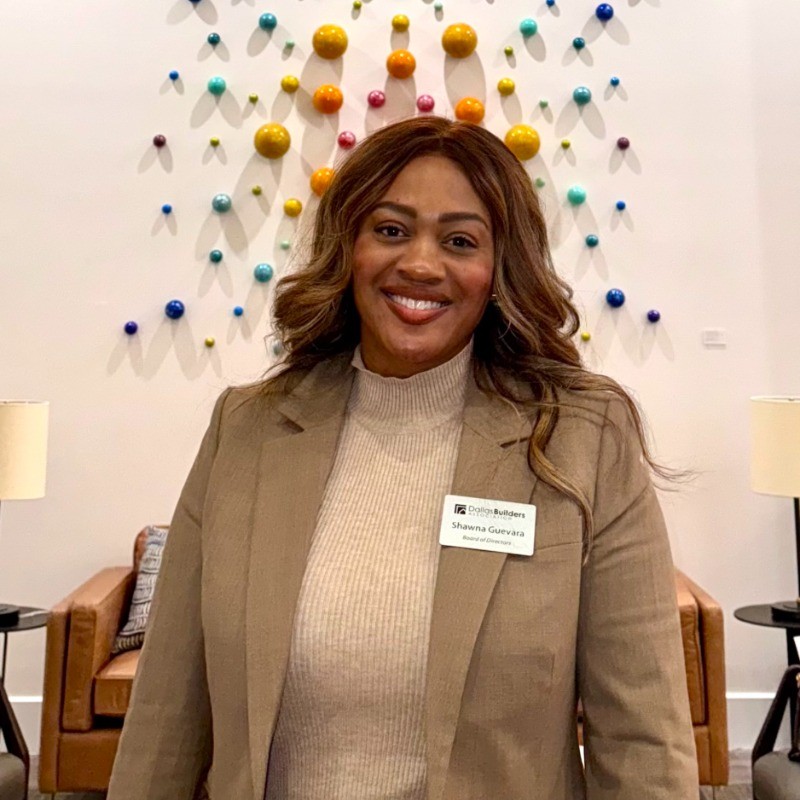
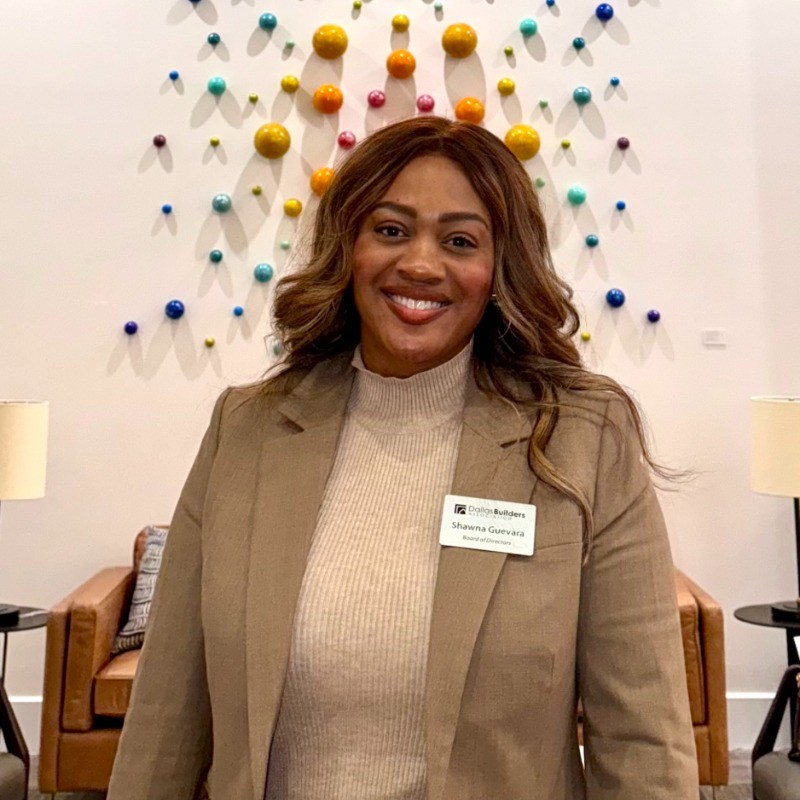
Dawn Price | K.A. Pierce Construction Safety Expert & Author of The Hands That Built This | Shawna Guevara Managing Director, Landmark Structural Builders |
Erin Lakenen | Melissa Drew | Svitlana Konovalova Manager, Best Choice Windows & Doors |
Jennifer Todd | Penny Austermiller President & CEO, Austermiller Roofing | Whitney Hill Co-Founder, SnapADU |
Key takeaways:
The number of women in construction increased by 45% over the past decade.
37% of women in construction are in leadership roles.
66% of the positions in sales and office are held by women.
There was a significant increase in service occupations, with women now accounting for 38% of the total workforce.
10 out of 12 experts we interviewed faced some kind of discrimination on their jobs.
9 out of 12 experts we interviewed confirm there is still a gender pay gap in the construction industry.
Year-on-Year Increase of Women in Construction Over a Decade
I would wholeheartedly encourage more women to enter construction; it’s a challenging industry, but it’s deeply rewarding and absolutely worth breaking barriers for.

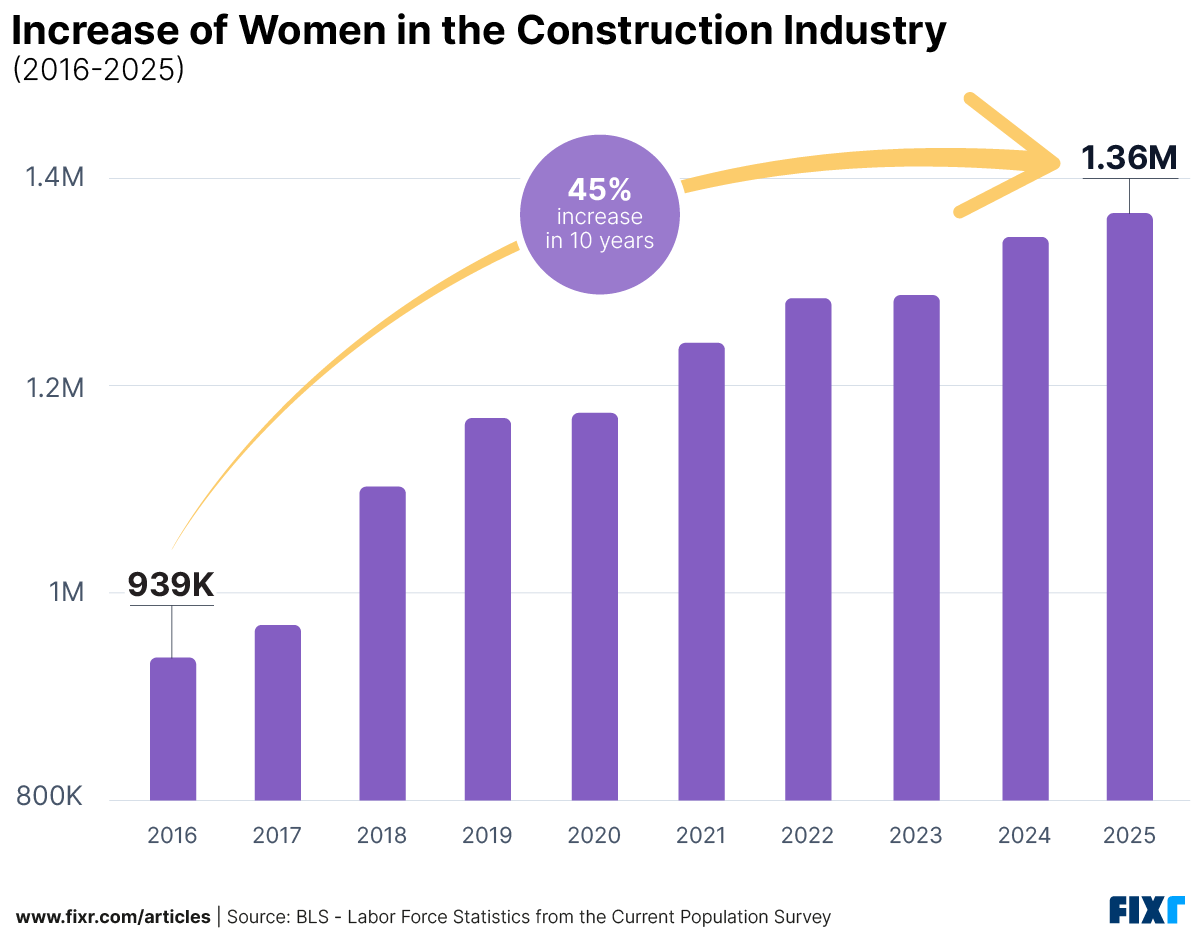 According to the latest data from the U.S. Bureau of Labor Statistics, the number of women in the construction industry has been increasing for the past 10 consecutive years. Between 2016 and 2025, the number rose from 939 thousand to 1,36 million, resulting in an overall percentage increase of 45%. An additional 22,000 women joined the construction industry in 2025, a 2% increase from the previous year.
Like all industries, there are many reasons why women may enter or leave the workforce; however, the continuous positive trend highlights the great work that events like Women in Construction Week™ are playing in growing these numbers.
Women's Representation in Construction Occupations
From my own experience, I’m incredibly proud of how far women have come in the 25 years I’ve been in this industry. I remember being one of very few women in my construction engineering classes in college, and now I see women not only thriving in management but also making meaningful strides in the trades and field supervision, which is amazing to witness.

Women's Roles Expand Across Construction Sectors
Women can work at the ground level in the trades, on the supplier side, in project management, operations, sales, estimating, ownership—every level of the industry.

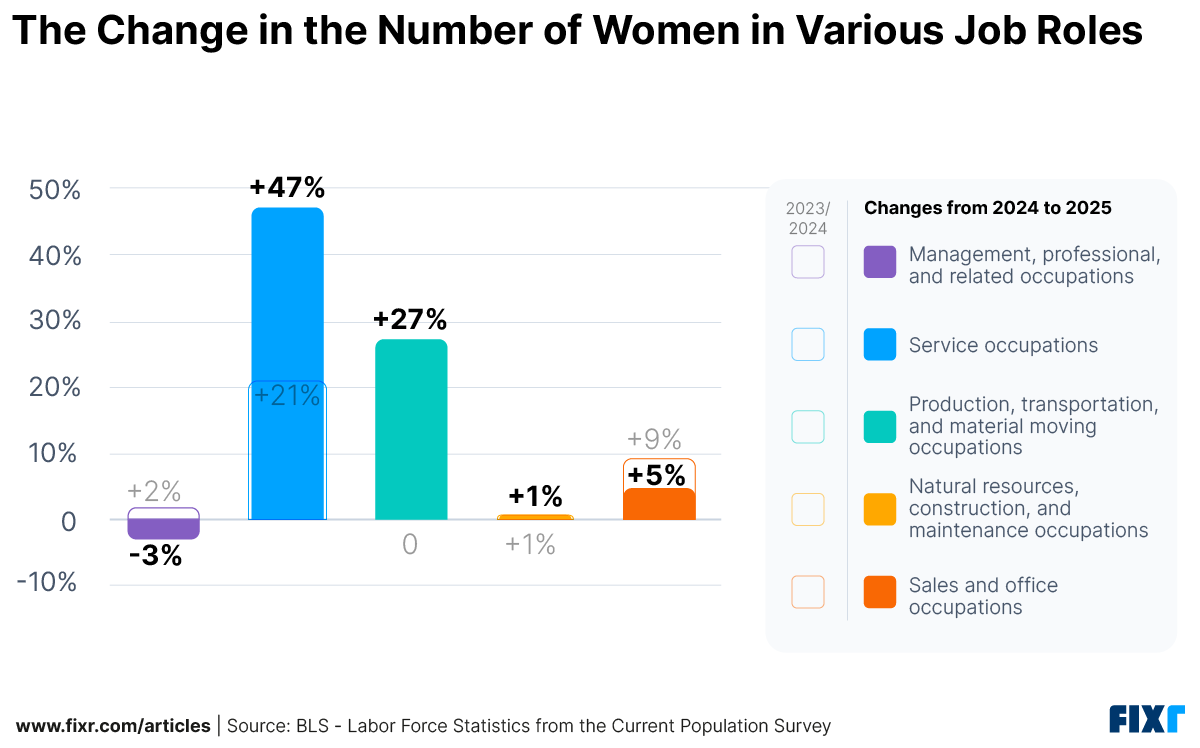 The distribution of women across the industry is shifting. While administrative and management roles remain the largest hubs for female employment, 2025 data shows a significant growth in technical and field-based positions.
Sales and Office Occupations: This sector saw the most significant numerical increase, adding 22,000 women in 2025, which is an additional 5% increase, bringing the total to 498,000.
Service Occupations: This was the fastest-growing sector proportionally, surging by 47% between 2024 and 2025, and bringing 8,000 additional female workforce.
Production, Transportation, and Material Moving: After stagnating in 2024, this sector saw a 27% jump in 2025, adding 6,000 new female professionals.
Management and Professional Roles: While this sector grew in 2024, it experienced a slight 3% dip in 2025. Experts suggest this may indicate a shift from corporate management toward specialized technical roles or business ownership.
Natural Resources and Maintenance: This sector maintained steady, incremental growth of 1% year-over-year.
37% of Women in Construction Are in Leadership Roles
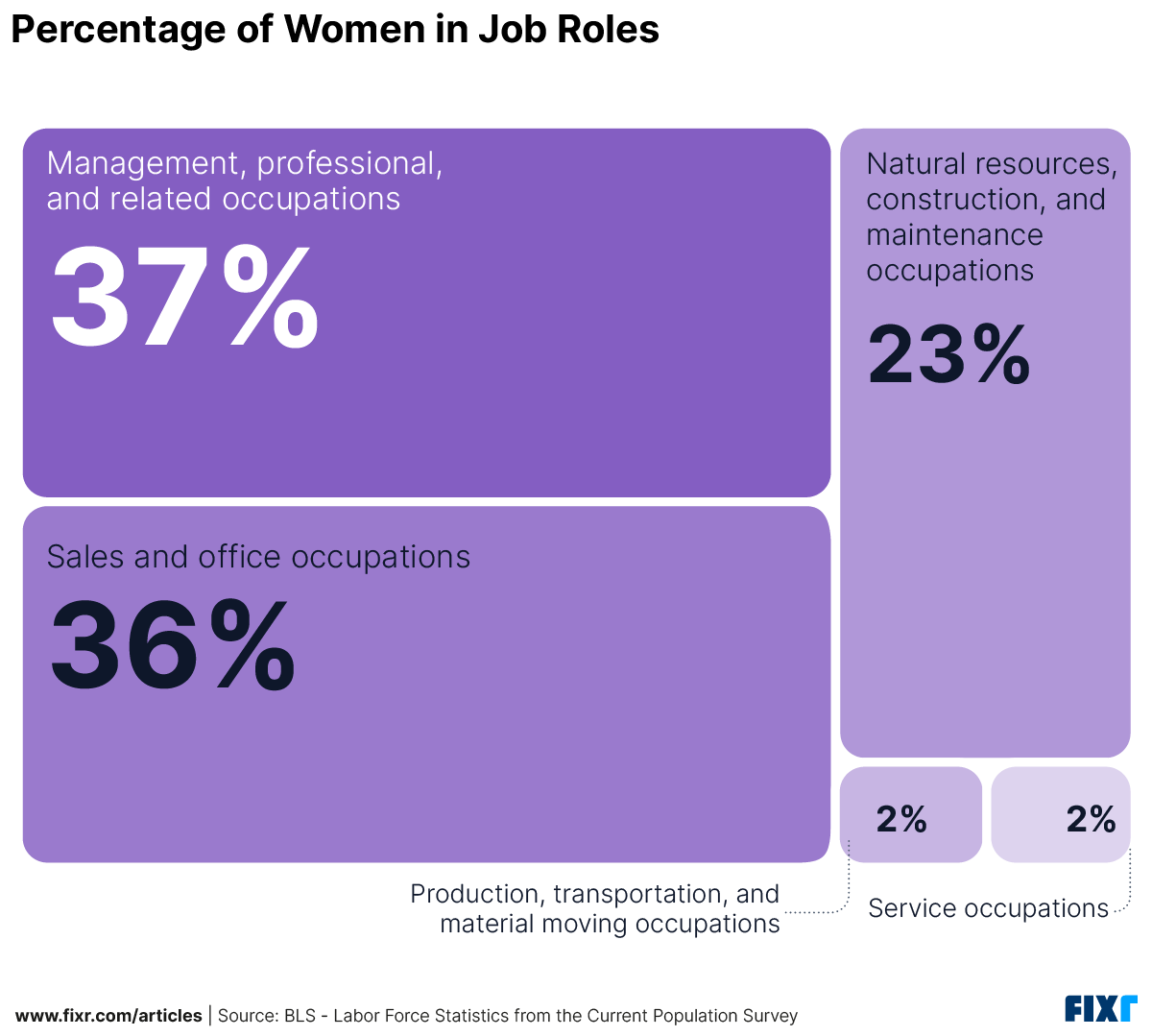 The percentage of women in construction is spread out through various sectors of the construction industry; however, the distribution is far from equal. The majority of women are employed in management, professional, and related occupations. In total, 506,000 (37%) make up this sector. They are followed by 498,000 (36%) women holding positions in sales and office occupations, and 309,000 (23%) women working in natural resources, construction, and maintenance occupations. Trailing significantly are the areas of production, transportation, and material moving with only 28,000 (2%) and service occupations even lower at 25,000 (2%).
Male Dominance in Four Out of Five Occupational Areas
While the industry has made progress, construction is still traditionally male-dominated, and changing long-standing perceptions takes time.

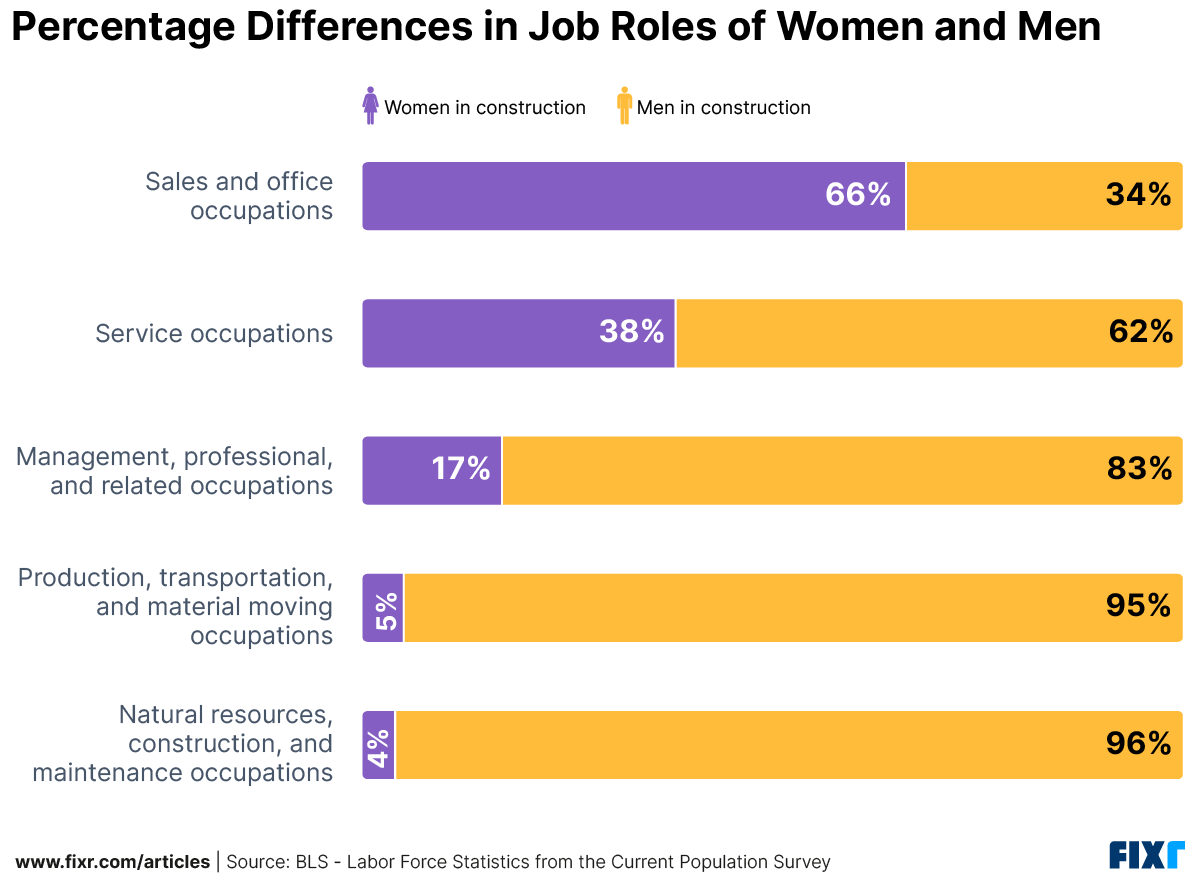 When examining women in construction, new statistics show that men still dominate four of the five occupational areas in the construction industry; however, women continue to make gains. In sales and office positions, women hold the majority, at 66%. There was a significant increase in service occupations, where women now make 38% of the total workforce.
Opportunities and Challenges for Women in Construction
The opportunities are actually very strong right now. There is high demand for skilled professionals in project management, estimating, operations, design consulting, and business ownership. Women bring valuable strengths such as organization, communication, client relationship management, and attention to detail, which are critical for successful construction projects
Women have more opportunities than ever in the construction industry, though challenges still exist. As the industry moves through 2026, it is actively working to attract women due to critical labor shortages and a growing awareness of the benefits of a more inclusive workforce.
Opportunities on the Rise
The industry needs women for the talent they bring, the perspectives they add, and the future they help build.

Regardless of role or trade, new opportunities are emerging—from mastering specialized crafts to redefining operational efficiency through AI and data.
Project management and estimating
Guevara highlights these as the most realistic and strategic paths: "As a Project Manager, you are coordinating every aspect of the jobsite. Building and logistics are the main components of construction, women have a natural talent for managing several moving parts that make a project run." She further notes that Estimating is a "game of high stakes puzzle solving. You are forecasting the future, while trying to mitigate risk, all while working with multimillion dollar budgets. Women tend to excel in estimating because we look at the whole picture, not just a piece of it."
Technology, innovation, and sustainability
With the digital transformation of the industry, roles centered on systems and data are expanding rapidly. Austermiller notes that "with digital transformation, automation, and green building trends accelerating, women have opportunities in tech integration, data analysis, [and] sustainability leadership." Hill explains that "expertise is no longer about hoarding knowledge. It is about judgment... about knowing which details matter, which trade-offs are acceptable, and how decisions cascade through cost and schedule."
Skilled trades and technical specialties
The labor shortage has transformed the field into a path for financial independence. Pierce emphasizes that "Everything is fair game. Welders, electricians, plumbers, HVAC technicians, manufacturing, mechanics, and carpenters – they are all viable options for women who want to work." Lakenen highlights the benefits of this path: "Women have the opportunity to come in, get paid to learn a skill, and build a stable career with great benefits and retirement. You can have a successful future without student loan debt."
Business ownership and executive leadership
More women are moving from employees to owners. Austermiller points out that "Women now own a growing share of construction businesses, from subcontracting firms to specialty services. Access to capital, business education, and industry networks makes entrepreneurship a realistic and rewarding path." She also sees women "stepping into CEO, COO, CFO, and VP roles at a faster pace than ever before, shaping strategy and culture at the highest levels."
Design consulting and field operations
Konovalova sees high demand in "design consulting" and "technical specialists," while Bykhovskaia adds that in specialized sectors like roofing, roles such as "field supervisor, production manager, customer service, [and] marketing" are wide-open opportunities.
Ongoing Challenges
10 out of 12 experts we interviewed faced some kind of discrimination on their jobs.
Hill defines it as positive discrimination. “Successful builders are often especially willing to help me and want to see me succeed because they know there are not many women in this industry. There is a sense that if one of us breaks through and builds something meaningful, it reflects well on the broader industry.”
The credibility barrier - Doubt Tax
The additional emotional, mental, and professional energy that marginalized individuals must expend to prove their basic competence before they are granted the same level of trust or authority that their peers receive by default.
“Being taken seriously is still a big hurdle for women who want to work in the trades. It was that way when I was on my tools, and it is still being faced today. Men just don’t think women can do the job,” says Pierce. Collins notes that "women are still often viewed as inferior in this space. There’s an underlying assumption of, 'What would a woman know about construction?'... Many women still have to prove their knowledge and credibility before they’re taken seriously."
Konovalova adds that "many clients, vendors, or subcontractors initially assume that a woman is handling only administrative work, not project management or decision-making." Todd points out “the additional emotional and professional energy women in male-dominated industries must expend just to be trusted. You prove competence before you're given the room others walk into freely. That doubt tax doesn't just exhaust women, it drives them out. It impacts retention far more than recruitment. And here's what the industry needs to understand: the Doubt Tax isn't a women's issue. It's a leadership failure.”
Jobsite logistics and safety
Practical barriers still deter female participation. Guevara highlights "basic site logistics," noting that "on smaller projects you may find yourself sharing a porta-potty with the entire crew." Lakenen points out a lack of "needs specific to women—like proper fitting PPE, adequate bathroom facilities, and inclusive jobsite culture."
Societal norms and support systems
Price shares that "being a strong woman can be seen as, 'Oh, she is aggressive.' Well, I would hope so, because you are playing in a man’s field." Drew notes that while management has advanced, the field trades are "slower to come around in fully accepting women," citing a "tragic case of a female welder whose safety concerns were dismissed" as a reminder of the work left to do.
Work-life balance
“Women face childcare hurdles in almost every industry,” says Hill. “They are somewhat exacerbated in construction because so much more of this industry is still in person. Construction has historically rewarded physical presence. That can create friction for women, particularly mothers, who are optimizing around school pickups, caregiving, or simply wanting more autonomy over how they structure their day.”
Subtle confidence gap
“There is also still a subtle confidence gap that shows up in rooms where most people have spent decades in a male-dominated field,” notes Hill. “Even in informal settings, men often dominate the conversation. It takes time and repetition for women to build the same comfort level asserting themselves in those spaces. “
The Gender Pay Gap: A Nuanced Challenge
9 out of 12 experts we interviewed say there is still a gender pay gap in the construction industry.
The consensus among experts is that while the industry is closer to parity than many other sectors, a gap persists. However, the nature of this gap in 2026 is often tied to union status, leadership representation, and what experts call the "opportunity gap."
Union vs. non-union parity
One of the strongest tools for closing the pay gap has been the unionized sector, where wages are standardized and transparent.
Pierce explains that the gap is "more so in the non-union sector," whereas in unions, "everyone makes the same amount of money unless you are a foreman, general foreman, or superintendent."
Lakenen agrees, noting, "I’m proud and grateful to be a union member because our wages and benefits are negotiated and transparent. That structure helps ensure we’re paid fairly and equally for the same work."
Todd adds that while "unionized environments in the skilled trades can reduce pay disparity... gaps persist in leadership compensation, bonuses, ownership stakes, and advancement."
The representation gap
Several experts argue that the "pay gap" is often a symptom of a deeper "representation gap".
Konovalova believes "the gap is often related more to representation in higher-level positions rather than unequal pay for the same role. As more women enter leadership, ownership, and specialized positions, this gap continues to close."
Drew confirms that entry and mid-level roles are more balanced than higher-level senior roles. “At entry and mid-level management roles, I’ve seen compensation become more balanced, but at the senior leadership level, in base salary, bonuses, and promotion opportunities, I believe meaningful gaps still remain, and progress to close them has been slow."
Hill suggests a different perspective, noting that what she sees "more often is a participation gap," questioning if "women’s lifestyles align with construction norms, and whether they are even considering these jobs in the first place."
The path to total parity
For those who see an ongoing discrepancy, the solutions are rooted in transparency and advocacy.
Guevara says that "companies that pay equitably retain better talent. She adds, “It is important that women, no matter the industry, are vocal advocates for their own value during salary negotiations."
Austermiller emphasizes the need for structural change: "closing that gap takes intentional pay reviews, transparency, and leadership accountability."
Brown concludes that while the industry is "better at parity than most," the fact remains that in "office, management and ownership roles, the gender pay gap is still not zeroed out."
Expert Strategies for Attracting and Retaining Women in Construction
The most effective approaches address the full arc not just getting women in the door, but keeping them.

To build a sustainable workforce, our experts recommend:
Early exposure: “Teach your girls early not to be afraid to try out a hammer or saw, or to work on an engine," says Pierce. Drew adds, "We need to expose girls in middle school and high school... not wait until college internships." Konovalova agrees that “Introducing construction careers to young women through schools, trade programs, and mentorship can help break stereotypes.”
Collins explains, “We need to bring the trades back into schools so young women can explore different skill sets early on. We also need:
More trade programs in local communities
Strong apprenticeship programs
Internship opportunities
Exposure to real-world construction environments
When women are introduced to the industry early and given hands-on opportunities, they can see the path forward.”
Visibility: Guevara believes in the power of representation: "When a girl sees a woman leading a multimillion dollar jobsite the conversation shifts from 'Can I do that?' to 'How do I get that job?" Konovalova agrees that “seeing successful women in construction leadership roles shows that it’s possible.”
Gender neutralization: Breaking the common beliefs is one of the most important strategies for attracting more female talent to the industry, and according to Hill, “Demystifying the industry and breaking some of the old-school perceptions around it being a man’s job is really the biggest one.”
Mentorship and sponsorship: Todd advocates for a shift: "There's a real difference between someone who advises you and someone who advocates for you in rooms you're not in yet." Lakenen thinks that “Mentorship is also really beneficial- having someone you can ask questions and learn from helps with education, recruitment and retention.”
Cultural modernization: Austermiller concludes that "equity requires continued, intentional change in culture, policies, and leadership development." She believes that “When we honor the trailblazers, modernize the culture, and intentionally invest in women, the industry grows stronger for everyone.”
Promoting flexibility: “Flexibility is key for the modern workforce,” pointed out Brown. Hill says that the one way to attract more talent is “Promoting hybrid and remote work where feasible opens the door for a broader pool of talent. Construction always requires field presence, but not every role requires regular onsite presence.”
Support for Women in Construction
There are local and national organizations built specifically to support women in construction. Find one, get involved, and stick with it. The community within these groups is real and having a network of women who understand exactly what you are dealing with makes all the difference.
Support for women in construction is more prevalent today than ever before. There are many organizations that promote gender equality, provide networking and mentorship, support education and training, advocate for policy changes, celebrate women's achievements, and foster inclusivity in the construction industry. The following are some of these organizations:
A Message for Women Starting in the Industry



Keep learning. Keep growing. When people see your skill set and knowledge, the gap starts to disappear. I can talk the same talk, negotiate the same deals, and understand the same challenges. When your talent speaks for itself, the conversation shifts. It’s no longer about who’s in the room—it’s about how we’re moving the business forward.

What I would add from my own experience is that this industry can change your life if you let it and truly believe you belong here. There were seasons where I walked into rooms knowing I had to work harder, speak louder, and prove myself more than others. But I also learned that strength isn’t just surviving those moments; it’s rising above them and choosing to lead with excellence, integrity, and heart. My hope is that every woman who steps into construction knows this: you belong here, your voice matters, and your impact can be greater than you ever imagined.


Construction allows you to build something real, something lasting. It has given me the opportunity to grow not only as a business owner, but also as a person, a leader, and a mother. I hope more women feel encouraged to enter this field, because there is absolutely space for them to succeed.

No two days in construction are the same. If you are someone who hates the daily grind and dreads the idea of sitting at a desk staring at the same spreadsheet for the next 10 years, construction might be exactly what you are looking for. Construction will challenge you, surprise you, and on many occasions frustrate you, but you will never be bored!


Construction has given me a career I’m proud of, and allows me to live a life I love. I have financial stability, opportunities for growth, and the security of being in a high-demand industry. Also, I genuinely enjoy my job, and I know that’s a luxury many people can’t relate to. It hasn’t always been easy, but it’s worth it. I hope more women consider it, because there is absolutely a place for us here- and the industry is better when we’re part of it.

Women in Construction Week FAQ
While there isn't a single designated "month," March is the primary month for recognition as it hosts "Women in Construction Week".
First held in 1998 by the National Association of Women in Construction (NAWIC), the week serves several key goals:
Recognition: Celebrating the achievements and contributions of women in the industry.
Awareness: Highlighting the diverse career opportunities available to women, from manual trades to executive roles.
Inspiration: Encouraging the next generation of women to enter the field to help close the industry's significant skills gap.
Advocacy: Raising awareness of unique challenges, such as workplace culture and safety needs.
Firms and individuals can participate through various activities:
Attend specialized webinars or workshops.
Establish formal programs pairing industry veterans with newcomers.
Share success stories of female employees.
Evaluate hiring practices for gender-neutral language and implement blind resume reviews to reduce bias.
Yes—absolutely. Women can and do work on construction sites, across all roles and trades.
Construction sites are required to be safe for all workers, but women often face unique safety challenges that employers must address:
Personal Protective Equipment (PPE): A major concern is that standard PPE is often designed for male physiques. Proper safety requires equipment, like gloves and fall protection, designed specifically for women’s body types.
Facilities: Sites should provide clean, private, and accessible restrooms for female workers.
Workplace Culture: Safety also includes a "psychosocial" component, requiring zero-tolerance policies for harassment or bullying to ensure a respectful environment.
Yes. Numerous organizations provide specialized support and training:
Apprenticeships: Many firms offer paid apprenticeships in carpentry, electrical, and plumbing specifically targeted toward attracting women.
Non-Profits: Organizations like Women Into Construction and NAWIC provide employability training, work placements, and leadership development programs.
Mentorship Schemes: Industry-led programs pair less experienced women with mentors to help them organically progress their careers and build confidence.
Irena is an industry analyst and content specialist at Fixr.com, where she transforms complex data into clear insights that help readers make smarter financial decisions. She holds a degree in Economics and has been conducting personal finance research since 2018, bringing a strong analytical foundation to her work. Her insights have been featured in reputable outlets such as the Washington Examiner, Yahoo Finance, Fox40, and Forbes.
Read more